
Durable Accessories for Full Time Caravanning: 2026 Guide
Posted by Editorial Team on
Table of Contents
- What Separates Durable Gear From Weekend-Only Kit
- Water Management: Hoses and Filtration That Last
- Best Caravan Accessories for Off-Grid Living
- Does Off-Grid Solar Work in Rain? What Full-Timers Need to Know
- Towing, Levelling and Tyre Gear That Survives the Big Lap
- Weight Management for Full-Timers: Cutting Kilos Without Losing Capability
- Your Long-Term Caravanning Checklist
- Frequently Asked Questions
Last Updated: September 27, 2026
What Separates Durable Gear From Weekend-Only Kit
Durable accessories for full time caravanning are built and rated for continuous daily use, not occasional trips, so the difference shows in materials, serviceability and how each item handles constant UV, vibration and water. The failure pattern is predictable: thin-walled hoses split, cheap fittings corrode, and plastic goes brittle under Australian sun.
Repairability vs Replaceability: The Full-Timer's Test
The best question before buying is whether a part can be repaired or must be replaced. Full-time caravanning punishes disposable gear because you cannot wait until you get home to swap it out.
Apply this three-point test:
- Serviceable fittings: brass or metal components that can be re-sealed or re-tightened beat sealed plastic units
- Replaceable parts: a hose reel that accepts a new hose outlasts a moulded all-in-one
- Standard sizes: gear using common thread and fitting standards is easier to repair anywhere
| Gear Type | Weekend Kit | Full-Time Kit | Why It Matters |
|---|---|---|---|
| Water hose | Thin PVC, crimped ends | Flat food-grade, brass fittings | Repairable, tangle-free, lasts longer |
| Sullage hose | Short, light vinyl | 9m x 32mm memory vinyl | Handles larger shower vans |
| Water filter | Basic inline | 5 micron carbon inline | Protects tank, reduces algae |
| Levelling | Loose blocks | Stabiliser plates + ramps | Stable, visible, durable |
Water Management: Hoses and Filtration That Last
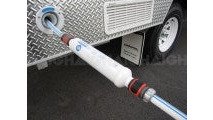
Water is where full-time setups fail first. A flat drinking water hose with a food-grade liner and solid brass fittings resists kinking, drains without drying, and stores tangle-free, which matters when you connect and disconnect daily.

Best Caravan Accessories for Off-Grid Living
The best caravan accessories for off-grid living prioritise power independence, water security and gear that works without a powered site. The biggest mistake full-timers make is buying one generic "off-grid kit" when their actual pattern is a mix of free camps and powered sites. The gear that survives a full lap suits the split you actually travel, not the one you imagine.

Match the kit to your real off-grid ratio
Most full-timers settle into one of three patterns. Each demands different gear:
- Mostly powered sites (70%+): You need a modest battery bank, a single portable solar blanket for top-ups, and a good inline filter. Spending big on lithium and fixed panels is wasted payload.
- Mixed (roughly half and half): This is the hardest setup to get right. You need enough battery to ride out two poor-solar days, a portable panel you can angle at the sun, and a filtration system that works from tank or town supply.
- Mostly free camping (70%+): Fixed solar, a properly sized battery bank, a secondary charging method (DC-DC from the vehicle or a small generator), and a filtration setup that does not rely on town water quality.
Power: sizing for the bad day, not the good one
The non-negotiables for most full-timers:
- Deep cycle batteries sized to your daily draw, not your best-case day. A useful rule of thumb is to size for three days of poor solar, because consecutive overcast days are the real test.
- Solar charging with a regulator that handles partial shade. MPPT regulators generally extract more from partial shade than PWM, which matters when you are parked under trees.
- 12v appliances chosen for low draw rather than peak performance. A 12v compressor fridge that draws 4-5 amps averaged over a day is a different beast from one that peaks at 10 amps and cycles hard.
- LED lighting to cut overnight power use. Replacing halogen with LED is one of the cheapest per-kilogram power savings you can make.
- A secondary charging method for extended wet spells. DC-DC charging from the tow vehicle while driving is the most common choice for full-timers who move regularly.
The Australian Government's energy guidance for off-grid and remote power is a useful starting point for understanding how solar and battery systems are rated, which helps you compare products honestly.
Water: two ways to filter, two ways to fill
Off-grid water security is about redundancy, not one clever gadget. Carry a primary inline filter for town supply and a secondary method (boiling, a gravity filter or a separate portable filter) for questionable sources. A 5 micron carbon inline filter protects your tank and reduces algae, but it is not a steriliser.
The weight-to-capability trade-off
Every off-grid upgrade adds kilograms. A second battery, fixed panel, generator and larger water tank can easily add 80-120kg. Before you buy, ask what each item does that a lighter alternative cannot. Repairable, multi-purpose items earn their place; single-use gadgets rarely do. The off-grid kit that works is the one you can still legally tow.
Does Off-Grid Solar Work in Rain? What Full-Timers Need to Know
Off-grid solar still works in rain, but output drops sharply because panels generate from light, not heat, and heavy cloud cuts the light reaching the cells. The system does not stop; it produces less, so the real question is whether your battery bank and charging setup can ride out several overcast days.
- Size your battery bank for three days of poor solar, not one
- Keep panels clean, since dust and grime cut output even in good light
- Angle panels to catch diffuse light, not just direct sun
- Carry a secondary charging method for extended wet spells
Towing, Levelling and Tyre Gear That Survives the Big Lap
Towing and levelling gear takes the most punishment of anything on your van, so it must be rated for constant load and repeated setup. Small, cheap components fail quietly here, and a failure at the wrong moment is more than an inconvenience.
Weight Management for Full-Timers: Cutting Kilos Without Losing Capability
Weight is the constraint most full-timers underestimate, and it compounds as gear accumulates. Every accessory adds to your payload, and exceeding it affects handling, braking and legality. But the angle most guides miss is the weight-to-durability ratio: not just how heavy an item is, but how many kilograms it costs per year of service life. A 2kg item lasting 12 months is heavier in practice than a 4kg item lasting five years, because you carry the replacement too.
Flat Drinkwater Hose & Compact Reel C-2 →
The weight-to-durability ratio
Apply this test to any accessory you are considering:
- Weight per year of service: divide the item's weight by the years you expect it to last. A cheap 1.5kg hose that fails every six months costs you 3kg per year in replacements. A 3kg food-grade flat hose that lasts five years costs you 0.6kg per year.
- Repairability multiplier: if an item can be field-repaired with a spare fitting rather than replaced entirely, its effective weight drops further, because you carry a 50g spare instead of a 3kg replacement.
- Multi-purpose penalty: gear that does two jobs well often weighs less than two single-purpose items, even if it is heavier on its own.
This is why the cheapest gear is rarely the lightest over a full lap, and why repairable gear wins on weight as well as cost.
Where the kilos actually hide
- Water: a full 100L tank is roughly 100kg. Travel with what you need and refill as you go. For most full-timers, carrying 30-50L between fills is a reasonable compromise between convenience and payload.
- Duplicate gear: two of everything is the most common weight trap. Two hoses, two filters, two sets of tools. Carry one good item and a small spares kit, not two full setups.
- Packaging and cases: collapsible, compact storage saves real weight over a year. Hard cases protect gear but add kilograms; soft, padded storage often does the same job for less.
- Heavy furniture and matting: choose lighter outdoor matting and collapsible items. A heavy annexe mat can weigh 15kg; a lighter woven alternative can do the same job at half the weight.
- Tools and spares: a full workshop is a common trap. Carry the tools you have actually used in the last six months, plus a small spares kit for the items most likely to fail.
The trade-off is real, but it is not always what you think
Lighter gear sometimes means less capability, so weigh each item against what it actually does for you. But the trade-off is often overstated. A lighter food-grade hose with brass fittings can outperform a heavier cheap one because it does not kink, split or corrode. A lighter lithium battery can outperform a heavier lead-acid bank because it delivers more usable amp-hours per kilogram.
Your Long-Term Caravanning Checklist
A long-term caravanning checklist keeps maintenance from slipping when you move every few days. The goal is a short, repeatable routine, not a long list you ignore.
Daily (5 minutes):
- Check tyre pressures and look for damage
- Confirm water and power connections are secure
- Secure stabiliser legs and plates before moving
Weekly (20 minutes):
- Inspect hoses and fittings for wear or leaks
- Clean solar panels
- Check battery charge and regulator readings
Monthly (1 hour):
- Deep-clean water filter and check flow rate
- Inspect tow coupling, chains and brake controller
- Review weight and remove anything unused
Seasonal:
- Service the caravan cover and check for UV damage
- Replace worn hoses, seals and fittings before they fail
Frequently Asked Questions
What is the 3-3-3 rule for caravans?
The 3-3-3 rule is a travel pacing guideline: drive no more than 300 kilometres, arrive by 3pm, and stay at least three nights. It reduces fatigue and setup stress on long trips. For full-time caravanners, this rhythm also limits wear on tyres, brakes and suspension because you are not rushing daily. It pairs well with a long-term caravanning checklist so nothing gets skipped between stops.
Which caravan accessories are essential for off-grid living?
Start with water and power. A food-grade flat hose and inline filter protect your tank, while deep cycle batteries, solar charging and a portable fridge handle daily needs. Add a UHF radio for communication, LED lighting to cut draw, and grey water management for free camps. Stabiliser plates, levelling ramps and a digital tyre pressure gauge round out the essentials. Durable accessories for full time caravanning should be chosen for repairability, not just price.
Does off-grid solar work in rain?
Solar panels still produce power in rain, just at a fraction of their rated output, often 10 to 25 per cent of clear-sky performance. Overcast days extend charging time significantly. Full-timers should size their battery bank for two to three days of autonomy and carry a backup such as a DC-DC charger or generator. Keeping panels clean and angled helps, but expect to reduce 12v appliance use during wet spells.
How do you choose durable gear for long-term travel?
Look for repairability, materials and real-world service life. Food-grade liners, brass fittings and UV-stable plastics outlast cheap alternatives. Check whether parts like hose fittings or filter cartridges can be replaced individually. Weight matters too: collapsible gear and compact storage protect your payload capacity. A $265 flat hose that lasts years beats a $90 hose replaced every season, especially when you are living in the van full-time.
What should be on a long-term caravanning checklist?
A practical checklist covers water, power, towing and safety. Include hose and filter checks, battery and solar inspection, tyre pressure monitoring, brake controller test, stabiliser leg and plate condition, and a hitch lock check. Add grey water management, awning and annexe setup, and a maintenance schedule for seals and bearings. Review it monthly, not just before departure, so small issues are caught before they strand you.
Are expensive caravan accessories worth it for full-time living?
For full-timers, yes, when the price reflects materials and service life. A $38 inline filter that treats up to 6000 litres, or a $265 flat hose with a food-grade liner and brass fittings, costs more upfront but avoids replacements and tank problems. The maths changes for weekenders. If you live in the van, buy for durability and repairability; if you camp twice a year, mid-range gear is usually enough.
Share this post
- Tags: best caravan accessories for off-grid living, does off-grid solar work in rain, durable accessories for full time caravanning, full time caravanning, long-term caravanning checklist