
Is Australian Made RV Gear Better? A 2026 Guide
Posted by Editorial Team on
Table of Contents
- What Actually Makes Australian Made RV Gear Different
- How to Verify Australian Made RV Gear Before You Buy
- Build Quality and Materials: Where the Difference Shows
- Durable RV Gear for Outback Travel: Testing Against Real Conditions
- Australian Consumer Law Warranty Rights Every RV Owner Should Know
- Long-Term Cost of Ownership: The Hidden Math
- Conclusion
- Frequently Asked Questions
Last Updated: September 18, 2026
What Actually Makes Australian Made RV Gear Different
Australian made RV gear is equipment manufactured domestically to withstand local conditions, using materials and testing standards suited to heat, dust and corrugations. The short answer to whether it is better: often yes, but only when you know what you are actually buying.
At RvOptions, we have sold Australian-made Solarscreen window insulation and locally built storage reels since 2009. The difference shows up in fit, materials and how the gear handles a long, hot lap rather than a weekend away.

What most guides miss is that "Australian made" is not one claim. It is a legal definition with thresholds. That distinction changes everything about how you should evaluate a purchase.
Below, we break down how to verify the claim, what it means for durability, and the long-term maths that imported gear rarely survives.
How to Verify Australian Made RV Gear Before You Buy
Verification starts with the Australian Made, Australian Grown logo, which is administered under a strict code of practice. The logo is not decorative. Products carrying it must meet a defined local content threshold and pass an audit.
Here is how to check a claim before you pay:
- Look for the official kangaroo logo, not a flag or a map outline
- Check the licence number on the Australian Made Campaign official register
- Read the label for "Made in Australia" versus "Assembled in Australia"
- Ask the seller which components are imported
- Confirm the business can name its manufacturer
The "Assembled in Australia" versus "Manufactured in Australia" distinction is the one most buyers miss. Assembled means imported parts put together locally. Manufactured means the product was substantially transformed here. Both can be legitimate, but they are not the same claim.
A common mistake is trusting a flag graphic on a product page. Only the licensed logo carries legal weight.
What the law actually says about country-of-origin claims
Country-of-origin claims on goods sold here are governed by the Australian Consumer Law, which prohibits misleading or deceptive conduct. The ACCC has taken enforcement action against businesses whose "Australian made" claims could not be substantiated, so the words on a label are not just marketing, they carry legal exposure.
For a product to be labelled "Made in Australia", it must have been substantially transformed here. The test is not where the box was packed or where the final screw was tightened; it is whether the product's essential character changed through a process carried out locally. A reel assembled from imported mouldings and imported bearings has not been substantially transformed, even if the assembly happens in a local workshop.
"Product of Australia" is a stricter claim again. It requires that all significant ingredients or components come from here and that all or virtually all of the production process happens locally. Very few RV accessories can honestly carry that label.
"Assembled in Australia" is not a regulated term in the same way. It describes a process, not a threshold, and it tells you nothing about where the value in the product actually sits. A product can be 90% imported by value and still be described as assembled locally.
The safe harbour defences
The ACL provides safe harbour defences for country-of-origin representations. A business that can show its claim aligns with the Australian Consumer Law's origin tests, or with a recognised standard such as the Australian Made Campaign's code, has a stronger legal position. This is why the licensed logo matters: it is an audited claim, not a self-assessment.
For a buyer, the practical takeaway is simple. A licensed logo with a verifiable licence number is a claim someone has checked. A flag, a map outline, a slogan like "Aussie owned" or a stock photo of a workshop is not.
The standards question nobody asks
Even a genuinely local product can be built to a weak standard. Ask which standard the gear is tested against. Australian Standards (AS) are written for local conditions, UV intensity, temperature ranges, dust ingress and corrugation vibration, and are not automatically equivalent to ISO or CE marks, which are written for different markets and different duty cycles.
Flat Storage Reel C-1 (Compact) →
A CE mark, for example, is a self-declaration by the manufacturer that a product meets European requirements (CE marking - obtaining the certificate, EU requirements). It is not a third-party certification and it says nothing about whether the product will survive a corrugated track in 45-degree heat. An AS mark on structural or electrical gear tells you the product was assessed against criteria written for this market.
This is the layer most buyers never reach. They check the logo, they check the price, and they stop. The standard behind the product is what actually determines whether it lasts.
Build Quality and Materials: Where the Difference Shows
Build quality in locally made gear usually comes down to three things: material grade, testing against local conditions, and component sourcing. Imported gear is often built to a price point for a different climate entirely.
Take canvas and insulated screens. Australian-made Solarscreen products are custom cut to a specific vehicle template rather than sold as a universal fit. That matters because a loose universal screen flaps, lets dust in, and fails at the seams within a season.
Galvanised steel, UV-stabilised plastics and heavy-duty canvas dominate local construction because they have to survive our sun. A storage reel built from heavy impact-resistant plastic and rated for 40 metres of 15 amp power lead is doing a job imported lightweight reels simply are not designed for.
Durable RV Gear for Outback Travel: Testing Against Real Conditions
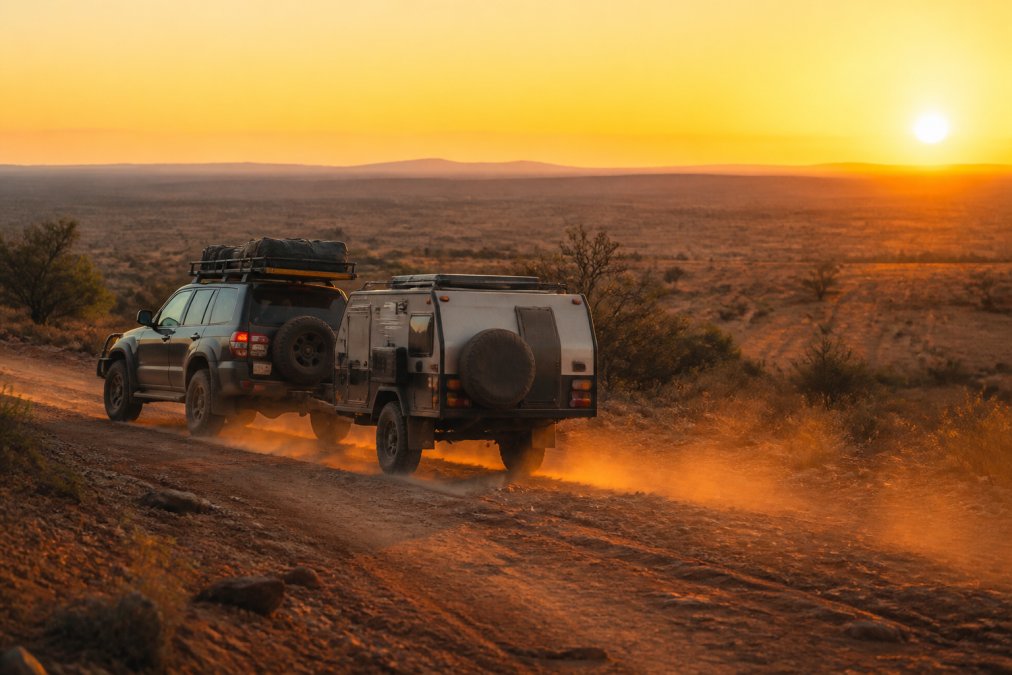
Durable RV gear for outback travel is equipment proven against corrugations, dust ingress, extreme heat and long distances between service points. The testing that matters happens on real tracks, not in a showroom.
Australian Consumer Law Warranty Rights Every RV Owner Should Know
Australian Consumer Law gives every buyer automatic consumer guarantees that sit alongside any manufacturer warranty. These rights apply regardless of what a warranty card says.
Long-Term Cost of Ownership: The Hidden Math
Cheaper gear rarely stays cheaper. The long-term cost of ownership calculation includes replacement frequency, repair downtime and the cost of a failure mid-trip.
| Factor | Locally Made Gear | Cheaper Imported Gear |
|---|---|---|
| Upfront cost | Higher | Lower |
| Expected lifespan | Several seasons | Often one season |
| Replacement cycles over 5 years | 1 | 2-3 |
| Spare parts access | Local, fast | Often unavailable |
| Warranty claim path | Direct and enforceable | Difficult overseas |
| Resale value | Holds better | Minimal |
Why the table understates the gap
The table above captures the visible costs. The real difference sits in three places most buyers never model.
The five-year worked example
Take two storage reels. The local reel costs more upfront. The imported reel costs less. Over five years, the local reel is bought once. The imported reel is bought two or three times, because it fails at the seams, the housing cracks under UV, or the internal spring loses tension.

Conclusion
Choosing gear for a big lap or a full-time life on the road means weighing upfront price against how long it will actually last. RvOptions stocks Australian-made Solarscreen window insulation and locally built storage reels precisely because they survive the conditions our customers travel through. Every product is backed by personalised advice from a team that uses the same gear in its own vehicles, and our long-standing partnership with the Campervan & Motorhome Club of Australia reflects that commitment.

Frequently Asked Questions
How can I verify if RV gear is genuinely Australian-made?
Look for the Australian Made logo, which requires certification against the Australian Made Campaign's rules. The key distinction is between 'Made in Australia' and 'Assembled in Australia', the former requires substantial transformation here, while the latter can mean imported components simply put together locally. Ask the supplier for the country of origin on materials and components, not just the final assembly point. Brands that are transparent about their supply chain and can name their manufacturers are usually the ones with nothing to hide.
Does Australian-made RV gear offer better durability in harsh climates?
It often does, because gear designed for local conditions accounts for UV intensity, corrugations and temperature swings that imported products may not be tested against. Products built with galvanised steel, heavy impact-resistant plastics and UV-stable canvas tend to hold up better over years of touring. That said, durability depends on the specific product and materials, not the label alone. Check what the manufacturer says about the materials used and whether the design was tested on local roads and in local conditions.
What are my warranty rights under Australian Consumer Law if RV gear fails?
Australian Consumer Law gives you automatic guarantees that products are of acceptable quality, fit for purpose and match their description. These rights apply regardless of any express warranty period. If gear fails prematurely or doesn't do what it was sold to do, you're entitled to a remedy, repair, replacement or refund depending on the severity of the failure. Keep your receipt and document the fault with photos. If the seller won't help, you can escalate to your state consumer affairs body or the ACCC.
Is it worth paying more for Australian-made camping and RV accessories?
It depends on how you travel and how long you plan to keep the gear. For weekend trips, a cheaper import may serve you fine. For full-time travellers or grey nomads doing the big lap, locally made gear often works out cheaper per year of service because it lasts longer, spare parts are easier to source and warranty support is straightforward. Run the numbers over a five-year horizon rather than comparing sticker prices, and factor in replacement costs for anything that fails early.
Share this post
- Tags: australian consumer law warranty rights, australian made rv, durable rv gear for outback travel, how to verify australian made rv gear, is australian made rv gear better