
Why Choose Australian Made RV Accessories: 2026 Guide
Posted by Editorial Team on
Table of Contents
- Why Australian Made RV Accessories Perform Better in Local Conditions
- How to Verify Australian Made RV Gear Before You Buy
- Australian Consumer Law Warranty Rights Every RV Owner Should Know
- Durable RV Equipment for Outback Travel: What Actually Survives
- Custom Fitment, After-Sales Support and Spare Parts Availability
- Environmental Impact and Regulatory Compliance of Local Production
- Frequently Asked Questions
Last Updated: September 23, 2026
Why Australian Made RV Accessories Perform Better in Local Conditions
Australian made RV accessories are engineered for the extremes of local travel, from coastal salt spray to outback dust and heat. This guide from RvOptions explains why locally manufactured gear lasts longer, fits better, and keeps you safer.

The core reason comes down to material integrity and design intent. Accessories built for overseas markets are often specified for milder climates and shorter trips. Gear made here is built by people who actually tow through corrugations, camp in 40-degree heat, and know what salt air does to cheap fittings. As the Australian Made Campaign explains, genuine local manufacturing means products are made to Australian standards and conditions, not adapted afterwards.
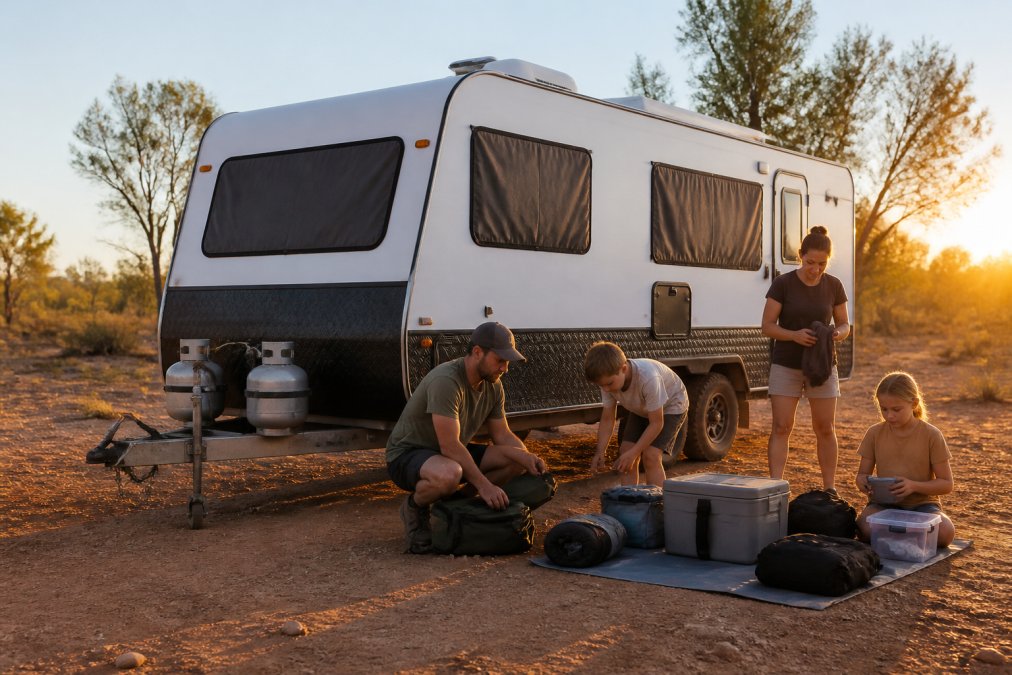
Material quality and corrosion resistance for coastal and outback travel
Corrosion resistance separates good gear from gear that fails in a season. Coastal camping exposes every metal fitting to salt, while outback travel brings fine dust that works into moving parts and wears through cheap coatings.
A common mistake is buying accessories with untreated steel fittings or low-grade plastics. They look fine in the shop and fail within a year of real touring. Look for marine-grade stainless hardware, UV-stabilised fabrics, and powder-coated or anodised surfaces, the difference between a screen that lasts five summers and one that cracks by the second.
Weight distribution, payload and towing safety considerations
Every accessory eats into payload and shifts weight distribution, something most owners only notice when the van sways on a highway or struggles up a grade.
Keep a running tally of added weight and check it against your vehicle's ratings. Mount heavy items low and over the axle, and avoid loading the rear of the van, which promotes sway. Towing capacity is a ceiling, not a target, and staying well under it gives you margin for water, fuel, and gear. Match load-bearing accessories such as roof racks and awnings to your actual setup, not guesswork.
How to Verify Australian Made RV Gear Before You Buy
Verification is straightforward once you know what to check. The Australian Made logo is a licensed trademark backed by a formal code of practice, not a free-for-all sticker.
Ask three questions before you buy: where was it actually manufactured, who stands behind the warranty, and can the seller show you the supply chain? A genuine local maker will answer all three without hesitation.
Australian Made logo, supply chain transparency and country of origin claims
Supply chain transparency is where local manufacturers pull ahead. Because production happens here, the maker can tell you exactly which factory cut the fabric, which supplier provided the hardware, and how the finished product was assembled.
Country of origin claims are regulated in Australia, so a business cannot simply print "Australian made" on an imported product. The Australian Competition and Consumer Commission enforces these rules and publishes guidance on what "made in Australia" and "product of Australia" actually require. If a seller cannot explain their claim, treat that as a warning sign.
Australian Consumer Law Warranty Rights Every RV Owner Should Know
Australian Consumer Law warranty rights give you automatic protections regardless of any voluntary warranty a seller offers. They cover goods that are faulty, unsafe, or not fit for purpose, and cannot be waived by fine print.
The practical value for RV owners is significant. If a screen or fitting fails well before it reasonably should, you may be entitled to a repair, replacement, or refund.
Durable RV Equipment for Outback Travel: What Actually Survives
Durable RV equipment for outback travel is over-built, serviceable, and designed for the conditions rather than the showroom.
On-road vs off-road configurations and terrain suitability
On-road and off-road setups are genuinely different, and mixing them causes problems. An on-road caravan is lighter and more efficient on sealed highways but will not tolerate rough tracks. An off-road build uses a stronger chassis, better suspension, and higher ground clearance, at the cost of weight and fuel economy.
Solarscreen Winnibago Sunseeker Rear →
| Configuration | Best For | Key Trade-Off |
|---|---|---|
| On-road | Sealed highways, caravan parks | Not built for rough tracks |
| Off-road | Remote tracks, unsealed roads | Heavier, higher fuel use |
| Hybrid | Mixed touring, occasional gravel | Compromise on both extremes |
Towing, payload and the regulations that govern them
Weight is where terrain suitability meets the law. Every state and territory regulates towing through its own road transport rules, and the practical limits most owners work to are gross vehicle mass (GVM), gross combination mass (GCM), tow ball download, and the trailer's aggregate trailer mass (ATM). These figures are set by the manufacturer and enforced through registration and, in some cases, roadside inspection.
Field-tested gear versus showroom gear
The difference between gear that survives and gear that fails shows up in the field, not on the shelf. Field testing in Australian conditions means UV levels that degrade untreated plastics within a season, salt air that attacks unprotected fasteners, and temperature swings that cycle adhesives and seals. A product tested here typically shows it: marine-grade stainless hardware, UV-stabilised fabrics, and serviceable components rather than sealed units replaced whole.
Custom Fitment, After-Sales Support and Spare Parts Availability
Custom fitment is the quiet advantage of buying local. A screen or cover cut to your exact vehicle make, model, and year fits properly the first time, meaning fewer gaps, less heat leakage, and no makeshift fixes on the road.
When ordering custom-fit gear, have your vehicle's year of manufacture, make, and model ready. A quick call to confirm fitment before ordering saves you a return and a delay.
Environmental Impact and Regulatory Compliance of Local Production
Local production carries a measurable environmental advantage through shorter freight distances and tighter manufacturing oversight. Goods made here do not cross an ocean, cutting the transport emissions attached to every accessory. Sea and air freight both carry a carbon cost per kilogram, and that cost is avoided entirely when a product is made and sold in the same market.
What ADR compliance actually means for RV accessories
The Australian Design Rules are the national standards for vehicle safety, anti-theft, and emissions, administered under the Road Vehicle Standards Act. They apply to vehicles and certain vehicle-related equipment, setting requirements for lighting, braking, and structural integrity. For RV accessories, the question is usually whether the product affects a regulated system: a roof rack that changes a vehicle's dimensions, a towbar that must meet a strength standard, or wiring that interfaces with the lighting circuit.
When a seller cannot name the standard their product meets, treat that as a gap in the supply chain rather than a gap in your knowledge.
Supply chain transparency and country of origin claims
Supply chain transparency is where local manufacturers pull ahead. Because production happens here, the maker can tell you exactly which factory cut the fabric, which supplier provided the hardware, and how the finished product was assembled. That traceability matters when something fails, because the maker can identify the batch and the cause rather than guessing.
Warranty access and local support
Warranty and support accessibility is the other half of the local manufacturing case, and the gap most buyers only notice when something goes wrong. Australian Consumer Law provides automatic guarantees regardless of any voluntary warranty, enforceable against the local supplier. When the supplier is overseas, enforcing them is impractical.
The environmental case, honestly stated
The environmental case is not absolute. Manufacturing still uses energy and materials regardless of where it happens; the advantage is one of distance, oversight, and accountability rather than a free pass. Local production also supports shorter, more visible supply chains, making it easier to verify claims about recycled content, low-VOC finishes, or responsible sourcing. For buyers who care about both footprint and build quality, local production tends to win on both counts.
Frequently Asked Questions
How do I verify if an RV accessory is genuinely Australian made?
Look for the Australian Made logo, which requires certification against the Australian Consumer Law safe harbour provisions. Check the product listing for a named manufacturer and an ABN. Ask the retailer directly where the product is made and whether they can provide a statutory declaration. If a seller cannot name the factory or the maker, treat the claim with caution. Reputable local suppliers will answer these questions without hesitation.
Are Australian made RV accessories more expensive than imported alternatives?
Upfront cost can be higher, but the gap narrows over time. Local products are often designed for harsher conditions, so they need replacing less often. Warranty claims are also easier to pursue under the Australian Consumer Law when the seller operates locally. For example, a Solarscreen Full Set for All Wagons at $560 may outlast several cheaper imported sets, which makes the cost per year of use lower.
Do Australian made products offer better warranty support for travellers?
Yes, in practical terms. The Australian Consumer Law gives you rights against the local supplier, including remedies for faulty goods, and those rights are easier to enforce when the business is based here. Local makers also tend to hold spare parts and offer phone support. RvOptions, for example, provides direct contact with the team for fitment questions and special orders, which matters when you are far from a major town.
Why is material quality important for RV accessories used in the outback?
Outback travel exposes gear to extreme heat, UV, dust and corrugations that break down cheap materials quickly. Australian made accessories often use thicker fabrics, UV-stabilised polymers and corrosion-resistant hardware. Solarscreen products, for instance, use nine layers of material for insulation and condensation control. That build quality reduces the risk of failure mid-trip, when replacements are hard to find and expensive to ship.
Share this post
- Tags: australian consumer law warranty rights, australian made rv accessories, durable rv equipment for outback travel, how to verify australian made rv gear, why choose australian made rv accessories