
Buy Custom RV Window Insulation Online: 2026 Guide
Posted by Editorial Team on
Table of Contents
- What Custom RV Window Insulation Actually Does for Your Setup
- Caravan Window Shade vs Thermal Curtains: Which Performs Better?
- How to Measure Caravan Windows for Insulation Before You Order
- Materials That Decide Performance: Reflective Foil, Bubble-Core and Multi-Layer Builds
- Attachment Methods Compared: Magnets, Suction Cups and Velcro
- Preventing Condensation in Caravans with Insulated Window Covers
- What to Check Before You Buy Custom RV Window Insulation Online
- Frequently Asked Questions
Last Updated: September 14, 2026
What Custom RV Window Insulation Actually Does for Your Setup
Custom RV window insulation is a made-to-measure thermal barrier that fits over your caravan or motorhome glass to reduce heat transfer, block UV, and control condensation. At RvOptions, we've supplied Australian-made Solarscreen covers since 2009, and the difference between a generic shade and a custom-fit screen is how precisely it seals.

Glass is the weakest point in any vehicle's thermal envelope: heat pours through caravan windows in summer and escapes in winter. A custom-fit insulated cover traps still air and reflects radiant heat before it enters the cabin.
Fit matters more than material thickness. A 2mm gap around a screen's edge lets convective heat circulate behind it, cancelling much of the benefit (energy.gov). Custom screens eliminate that gap.
Caravan Window Shade vs Thermal Curtains: Which Performs Better?
Thermal curtains slow heat transfer through fabric layers, while a caravan window shade built from reflective multi-layer material blocks radiant heat at the glass. For vehicle use, shades win on performance and packability.
Here's how the two compare:
| Feature | Thermal Curtains | Custom Window Shades |
|---|---|---|
| Heat reflection | Low to moderate | High (reflective foil layer) |
| Condensation control | Poor (fabric traps moisture) | Good (non-absorbent surface) |
| Packed size | Bulky | Flat, rolls or folds small |
| Fit | Generic sizing | Made-to-measure |
| Glare and light block | Partial | Near-total with blackout build |
Curtains work in a house with space and a fixed frame. In a caravan, they hang away from the glass, let heat circulate behind them, and hold damp. A reflective, custom-fit screen sits flush against the window and reflects heat before it crosses into the cabin.

How to Measure Caravan Windows for Insulation Before You Order
Measure each window's visible glass area at its widest and tallest points, then add 20-30mm overlap per side so the screen seals against the frame, not just the glass (energy.gov).
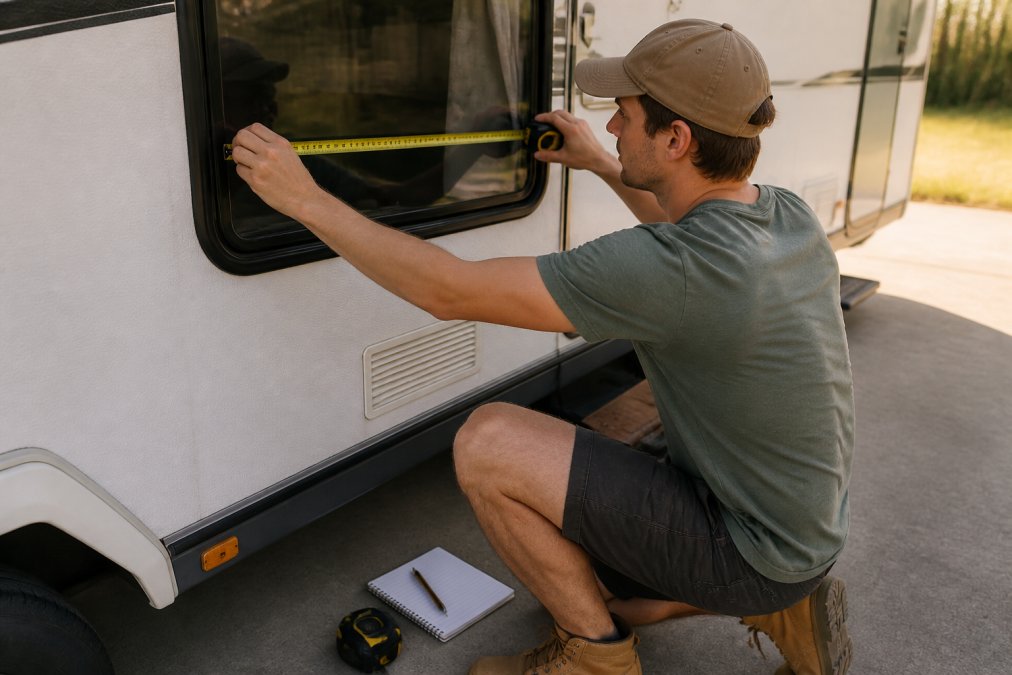
Follow this sequence for each window:
- Measure the width at the top, middle, and bottom; record the widest figure
- Measure the height at the left, centre, and right; record the tallest figure
- Note the corner radius if the window has rounded edges
- Sketch the window shape and mark any handles, struts, or hinges
- Photograph the window with the tape measure visible for reference
A common mistake is measuring the frame opening instead of the glass. Screens sit over the glass and overlap onto the frame, so measure the aperture you're covering, not the hole behind it. Many suppliers provide a template kit for irregular shapes such as hatch covers.

Materials That Decide Performance: Reflective Foil, Bubble-Core and Multi-Layer Builds
The best-performing window covers combine a reflective outer layer, a bubble-core or foam middle layer, and a durable facing. Each layer does a different job, and the stacking order matters as much as the materials.
Reflective foil bounces radiant heat back toward the glass, the dominant heat path through a sunlit window. Bubble-core creates trapped air pockets that slow conductive transfer and add a small amount of R-value. Multi-layer builds stack these with a protective skin so the foil doesn't tear after a season.
Single-layer foil is cheap and reflects well but punctures easily. Bubble-core alone insulates but doesn't reflect. Multi-layer builds cost more but perform better at both heat reflection and retention, which matters if you travel through cool high-country nights as well as hot coastal days.
The reflective layer only works if it faces the glass with an air gap (energy.gov). If the screen sits flat against the glass, you lose most of the reflective benefit. Installers commonly build in a 10-15mm standoff using the attachment hardware, magnets or Velcro tabs that hold the screen slightly proud of the glass.
What the layers actually do
| Layer | Primary function | Typical material | Trade-off |
|---|---|---|---|
| Reflective outer | Bounces radiant heat | Aluminised foil or metallised film | Punctures if unsupported; must face the glass |
| Core | Slows conductive transfer | Bubble wrap, closed-cell foam, or air-gap weave | Bulkier cores pack larger; foam can crumble with age |
| Facing | Protects the foil, wipes clean | Woven polyester, PVC, or coated fabric | Heavier facings last longer but add weight |
The durability question most guides skip
The real test is what happens after two or three summers of UV exposure. Long-term travellers report that single-layer foil covers delaminate or tear within 12-18 months, while multi-layer covers with a protective facing typically hold their reflective performance for three to five years before the foil oxidises or the facing fades.
Watch the edges (where layers are bonded) and attachment points (where stress concentrates). A cover with stitched or heat-sealed edges and reinforced attachment points outlasts one with glued edges every time. If buying online, ask how the layers are bonded and whether the edges are reinforced, that question separates a one-season cover from a five-season one.
Eco-friendly material sourcing
For full-time travellers in a small space, what the insulation is made from matters more than in a house. Look for low-VOC adhesives, recycled PET facings, or PVC-free construction.
Acoustic insulation: the secondary benefit nobody mentions
A thick multi-layer cover does more than block heat: the trapped air pockets that slow conductive transfer also dampen sound. Travellers parked near highways, busy caravan parks, or generator zones report that a well-fitted insulated cover noticeably reduces outside noise, not to silence, but enough to take the edge off. For light sleepers, that's a genuine reason to choose a thicker multi-layer build over thin single-layer foil.
Integration with existing window coverings
If your caravan already has curtains or blinds, you don't have to choose. Fit the insulated cover closest to the glass, then close the curtain or blind over the top: the cover handles radiant heat and condensation at the glass, while the curtain adds a decorative finish and a little extra thermal resistance. Avoid trapping the curtain between cover and glass, which creates a moisture pocket and defeats both.
For blinds that run in a track, check that the cover's attachment hardware doesn't obstruct the track. Magnets or low-profile Velcro tabs usually clear a standard track; bulky suction cup bases often don't.
Attachment Methods Compared: Magnets, Suction Cups and Velcro
Magnets give the fastest setup and removal, suction cups suit smooth glass with no frame to grip, and Velcro holds firmly but wears over time. Your window frame decides which works best.
| Method | Setup speed | Best for | Watch out for | Typical lifespan |
|---|---|---|---|---|
| Magnets | Fastest (seconds) | Metal frames, frequent removal | Won't grip alloy or plastic frames | 3-5 years if kept clean |
| Suction cups | Fast | Smooth glass, temporary use | Loses grip in heat and dust | 6-18 months |
| Velcro | Moderate | Any frame, semi-permanent | Adhesive degrades; hook side clogs | 1-2 years before adhesive fails |
Why magnets fail on alloy and plastic frames
Magnets need ferrous metal to grip, and most modern caravans use aluminium frames or composite panels. Before ordering a magnetic system, test your frame with a fridge magnet, if it doesn't stick, magnets won't work without an added steel strip, which most suppliers can provide but which adds cost and installation time.
Sign in or Create an Account →
If your frame is steel or you'll fit steel strips, magnets are the fastest system available: pull screens down in seconds for the view, refit them just as quickly when the sun swings around. The trade-off is that magnet pockets sewn into the cover add bulk at the edges, which can interfere with window seals on tight-fitting frames.
Why suction cups release in the heat
Suction cups rely on a pressure differential between cup and glass. In a hot caravan, the air behind the cup expands, the differential drops, and the cup releases, often mid-afternoon when you need the screen most. Dust and condensation break the seal further.
Suction cups suit occasional use, short trips, or a temporary measure while you decide on a permanent system. For full-time travel, they're the least reliable option. If you use them, clean the glass and cup with methylated spirits before each application and press firmly from the centre outward to expel air.
Why Velcro is the most universal but needs maintenance
Velcro (hook-and-loop) adheres to almost any frame material, making it the most flexible option. The weakness is the adhesive backing: on a hot caravan frame it softens, and over a season or two it can fail, leaving the hook strip stuck to the cover and the loop strip on the frame.
Use high-temperature adhesive Velcro rated for automotive use, and clean the frame with an alcohol wipe before applying. Even then, expect to replace the strips every 12-24 months. The hook side clogs with lint and dust, reducing grip, brush it out periodically.
The hybrid approach: magnets at the corners, Velcro along the edges
A hybrid system gives you the best of both: magnets at the corners for fast location and initial hold, Velcro along the edges for a continuous seal that stops convective heat leaking around the perimeter. Most full-time travellers converge on this setup after trying single-method options.
The practical build is four magnet pockets at the corners (six for large windows) and a Velcro strip along each edge. Position the screen with the magnets, press the Velcro edges down to seal, then reverse to remove. Setup takes 10-15 seconds per window once practised.
Matching method to frame material
| Frame material | Recommended method | Why |
|---|---|---|
| Steel | Magnets or hybrid | Magnets grip directly; fastest option |
| Aluminium | Velcro or hybrid with steel strips | Magnets won't grip without added steel |
| Plastic/composite | Velcro | Only method that adheres reliably |
| Glass-only (no frame) | Suction cups or Velcro on glass | Suction for temporary; Velcro for semi-permanent |
What to check before you order
Before choosing an attachment method, confirm three things: frame material (test with a magnet), frame width (Velcro needs at least 15mm of flat surface), and any protrusions, handles, struts, or hinges, the hardware must clear. A supplier who asks these questions expects the fit to work first time.
Preventing Condensation in Caravans with Insulated Window Covers
Condensation forms when warm, moist cabin air meets a cold surface, and single-pane glass is the coldest surface in most caravans. Insulated covers keep the glass warmer and block the moisture pathway.
Preventing condensation in caravans comes down to three habits: cover the glass so it stays closer to cabin temperature, ventilate while you cook and shower, and wipe down residual moisture each morning rather than letting it pool.
Fabric curtains make condensation worse: they absorb moisture and hold it against the frame where mould can start. A non-absorbent reflective screen wipes clean and doesn't feed mould, for a grey nomad living in the van for months, that's the difference between a dry interior and a recurring damp problem.
What to Check Before You Buy Custom RV Window Insulation Online
Confirm four things before ordering: exact measurements, attachment compatibility with your frame, material build, and whether the supplier offers a template kit for odd shapes. Getting these right first time avoids returns.
A practical checklist for buying online:
- Measurements recorded for every window, with overlap allowance
- Frame material identified (metal, alloy, or plastic) to match attachment type
- Material build confirmed as multi-layer with a reflective layer
- Template kit available if any window is irregular
- Supplier confirms Australian-made stock and fit support
One question worth asking any supplier: what happens if the fit isn't right? A seller offering measurement guidance and template kits expects to get it right first time. RvOptions stocks Australian Made Solarscreen covers and provides template kits for special orders, which is how we handle irregular hatch and window shapes.
On the "cheaper elsewhere" question: generic shades are cut to a standard size, not your window. They leave gaps, don't seal, and often use single-layer foil that tears within a season. Custom-fit screens cost more because measurement and cutting are done for your vehicle, that precision delivers the performance.
Keeping a caravan comfortable through an Australian summer is a window problem before it's an air-conditioning problem, and the fix starts with a screen that actually fits your glass. RvOptions has supplied Australian-made Solarscreen window insulation since 2009, backed by our long-standing partnership with the Campervan & Motorhome Club of Australia. Our custom-fit covers block heat and UV, control condensation, and are built to hold up on long-haul trips, not just weekend runs. Browse the Solarscreen range or request a special order and get the measurements right the first time.
Frequently Asked Questions
What is the best type of insulation for RV windows?
Multi-layer covers that combine a reflective foil outer surface with a bubble-core or foam middle layer perform best. The reflective layer bounces radiant heat away from the glass, while the bubble-core slows conductive heat transfer. Custom-fit covers made from these materials, such as Australian-made Solarscreen, block heat and UV while also reducing glare. Avoid single-layer bubble wrap, which offers limited thermal barrier performance and degrades quickly in strong sun.
Are custom-made window screens worth the investment for RVs?
Custom-fit screens are worth it if you travel regularly or live in your RV full-time. Off-the-shelf shades rarely match curved or angled windows, leaving gaps where heat and light leak in. A made-to-measure cover removes those gaps, stays put while driving and typically lasts several seasons. Expect to pay around $85 to $110 for a single custom rear window screen, depending on the model, which is modest compared with running an air conditioner harder all summer.
How do thermal window coverings help with condensation in caravans?
Condensation forms when warm, moist air inside the van meets a cold window surface. An insulated cover acts as a thermal barrier between the interior air and the glass, so the window surface stays closer to room temperature and moisture is less likely to condense. This reduces water pooling on sills, which is a common cause of mould and damp bedding. Pairing covers with daily ventilation, such as cracking a roof hatch, gives the best result.
Can I buy custom-fit insulation for older caravan models?
Yes. Most custom insulation suppliers work from a template kit rather than a model database, so older or discontinued caravans can still get a precise fit. You trace the window shape using the supplied template material, mark reference points and post it back. The manufacturer then cuts the screen to match. This approach also suits motorhomes with unusual rear or side window shapes, including curved glass and recessed frames.
Share this post
- Tags: buy custom rv window insulation online, caravan window shade vs thermal curtains, custom rv window insulation, how to measure caravan windows for insulation, preventing condensation in caravans